Translate

Friday, January 25, 2013

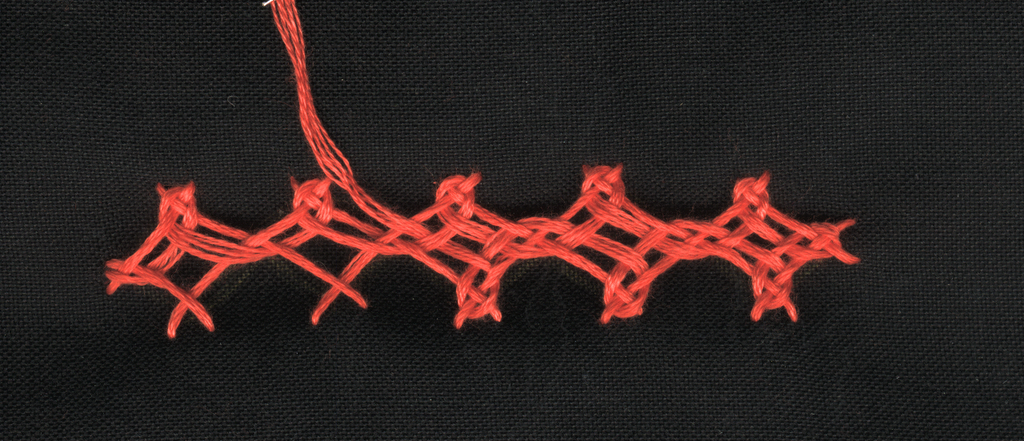
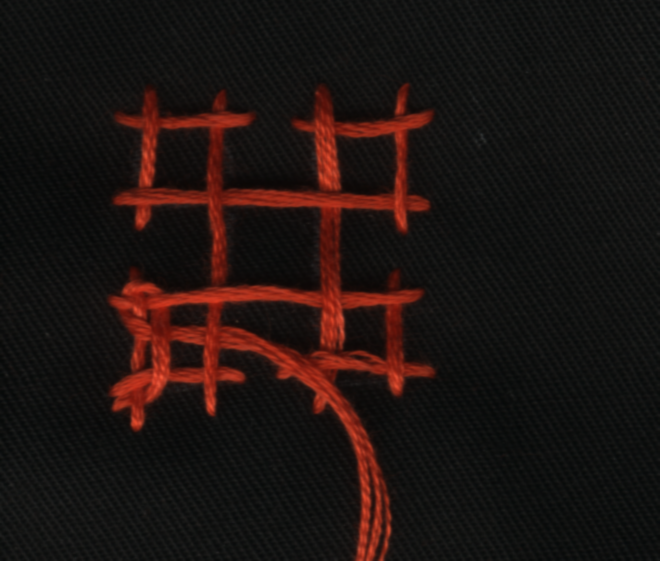
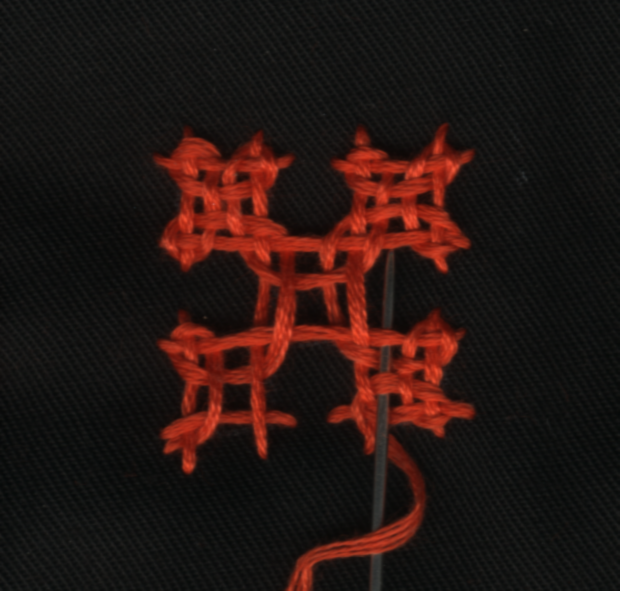
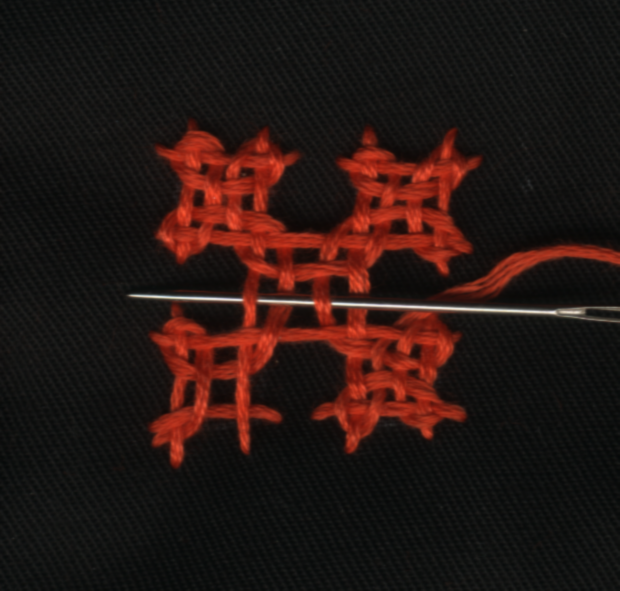
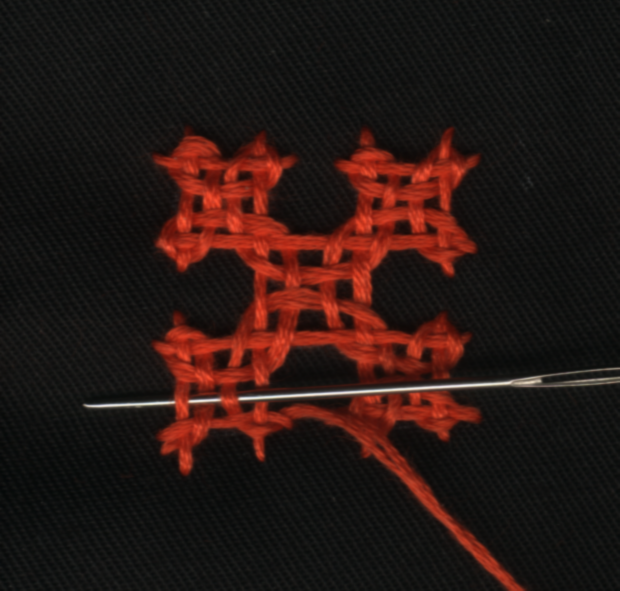
Kutchwork Kurta Design - Part III The Interlacing

Note: I've used 6 strands of Anchor Stranded cotton for both the skeleton and the interlacing. I normally use a tapestry needle for the interlacing. The reason? When you use an ordinary sewing needle, chances of your needle snagging the yarn and pulling at the already laid skeleton are high. This results in a shabby finish.  By using a tapestry needle, you eliminate this problem.

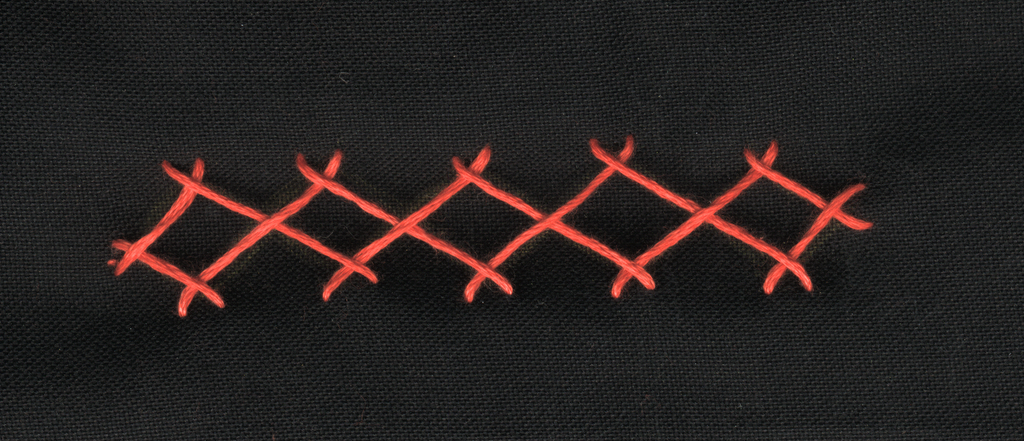
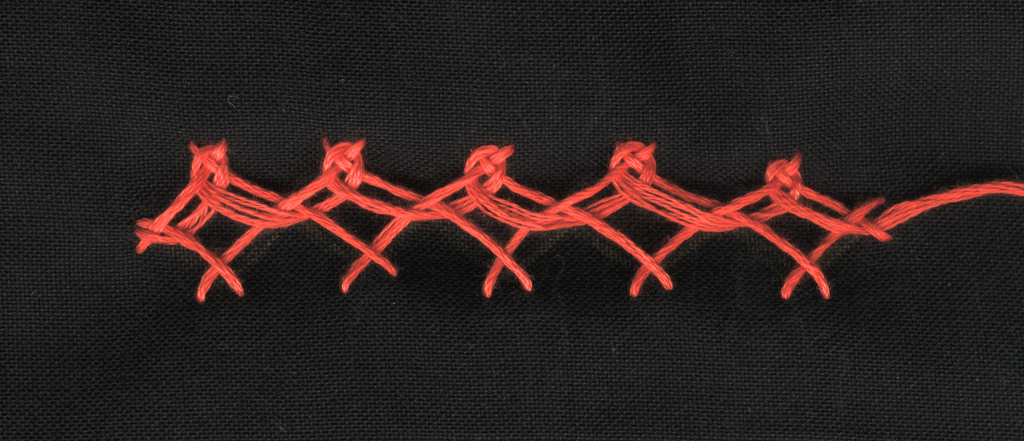
The Interlacing can be worked in 2 ways. The way I've done it for this kurta, and a 2nd method which produces a totally different effect.


Which method you choose depends on your personal preference.  I personally prefer Method II for 2 reasons.

1. It does not deviate from the normal rules of Kutchwork and is therefore, easier to remember. 
2. Method II looks more like Kutchwork than Method I.

Here Method I looks more attractive than Method II, mostly because, I've used different colors for working the skeleton and the interlacing. That you can clearly distinguish between the skeleton and the interlacing, adds an element of interest to the design. 

I'd choose Method I if I am working with 2 colours and Method II if I am working with a single colour.

Use 2-3 strands if you are working on silk or very fine material.
All 6 strands, if you are working the design on a cushion cover - you want the design to stand out and draw the attention of anyone who enters the room.
4 strands work just as well as 6. But in my experience, whenever I use 4 strands, I end up losing the remaining  2 strands. The result? A lot of wasted yarn.

I'll post the steps for each of these over the next 2 posts.

Design on Kurta Part I
Design on Kurta Part II 
Design on Kurta Part IV - Interlacing Method I
Design on Kurta Part V - Interlacing Method II

Kutchwork Kurta Design - Part II

Working The Skeleton
Here's the pattern transferred to the fabric using white carbon (available with all wholesale stationery dealers).

Working the Skeleton:
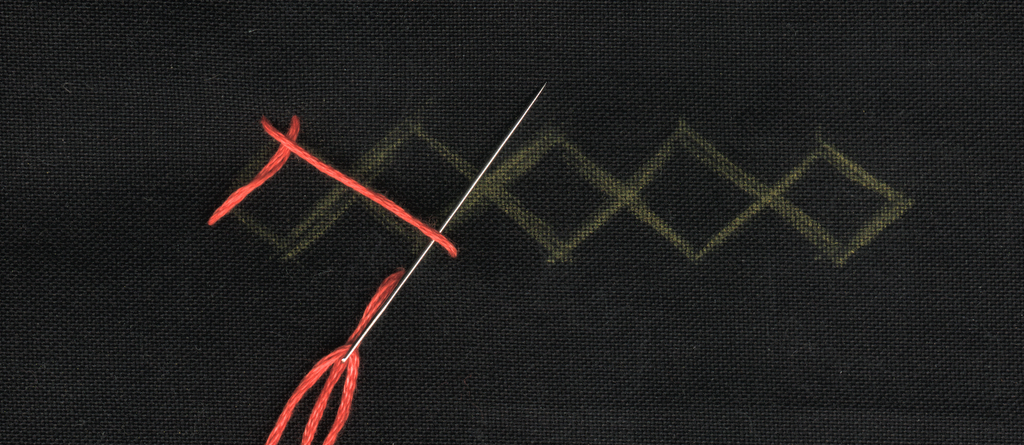
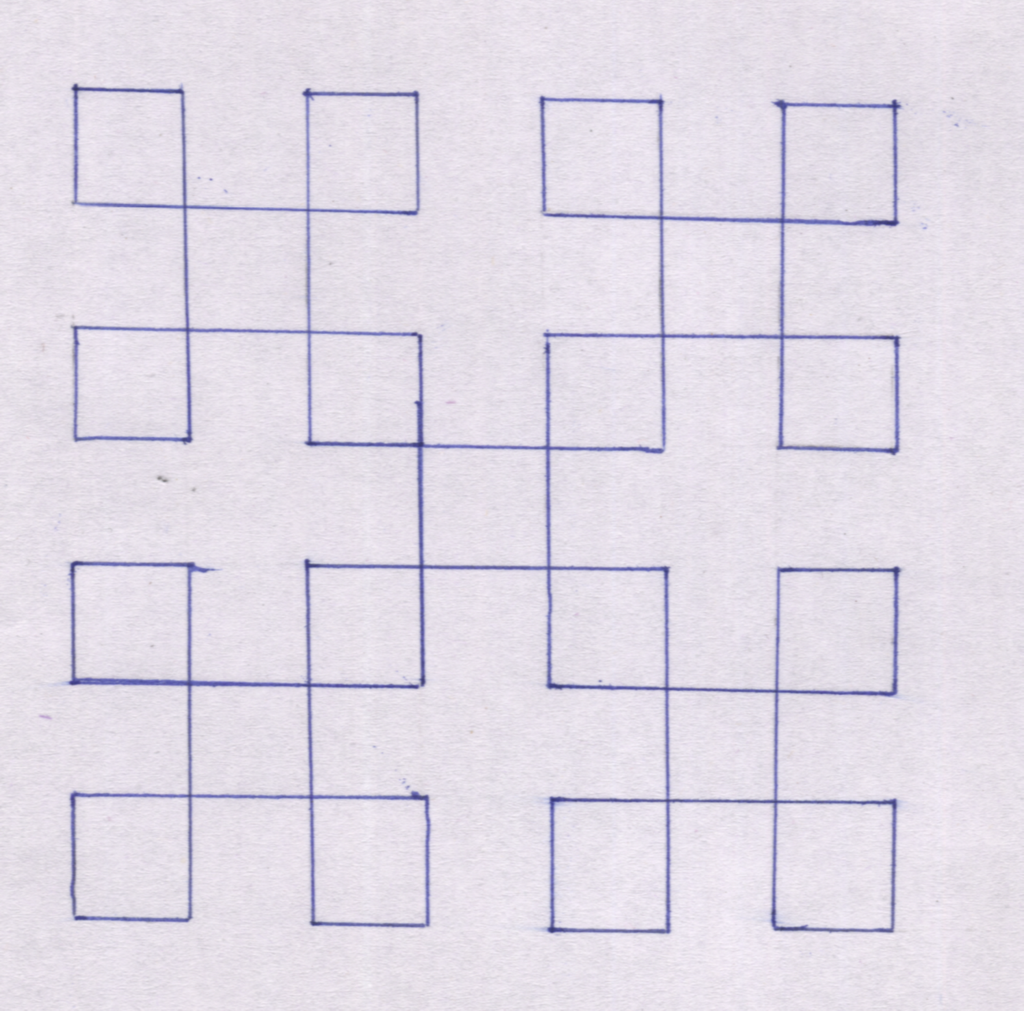
The first step to working a kutchwork pattern is to pick up a pencil and trace the design starting at any point. For this design, start at point 1 then move on to 2 etc and continue to trace it until you get back to one.


Note: I have numbered only 2 repeats of the pattern here.


Observe that you were able to trace the pattern continuously without taking the pencil off the pattern to start again elsewhere. This is the path your skeleton will take.

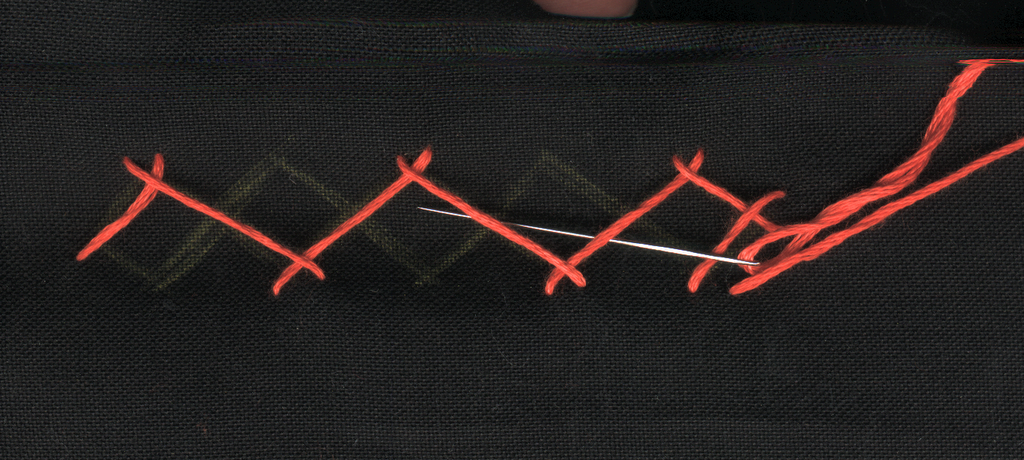

In the PIC 1 and PIC 2 below, I've striven to make my explanation for working the skeleton as clear as possible. I may even guilty of over explaining things. So, if you have grasped the general idea, simply ignore the rest.


Now the rest of the steps for working the skeleton.


This picture below shows you how to turn a corner (extreme right) in order to return to the starting point.



With the skeleton complete, you are now ready to work on the interlacing.

Design on Kurta Part I
Design on Kurta Part III
Design on Kurta Part IV - Interlacing Method I
Design on Kurta Part V - Interlacing Method II

Friday, January 18, 2013

Free Kutchwork Pattern For Kurtha - Part I

Kutchwork is what I'd pick if I want to embellish something and want it quick. You don't have to spend too of time on it. 

Unfortunately, some people find Kutchwork difficult. I'd say, they weren't taught Kutchwork the right way.

All that is required is to understand the concept of the unders and overs that give this type of embroidery an identity entirely its own.


Here is the  design I used on my Kurta. Click on the picture to enlarge. You can then print it out.


Working on the 1st pattern is easy enough. The second one is slightly complicated. I'll show how it should be worked in my next post.

I've used three strands of Anchor stranded cotton.

Tip: You can use the smallest motif with the satin stitch leaves around the neckline and the 1st motif can be spaced here and there on the kurta to give your outfit an exotic finish. 

Design on Kurta Part II
Design on Kutra Part III - Skeleton
Design on Kurta Part IV - Interlacing Method I
Design on Kurta Part V - Interlacing Method II

Saturday, January 29, 2011

Free Kutchwork Motifs

Heart Series II

These are my own designs.
You are welcome to use or share these designs.
But please don't sell them or copy and paste them on your site - if you copy and paste please mention where you found them.
Please do not redraw them and pass them off as your own either.
That's what put me off sharing for nearly 2 years.


Free Kutchwork Motifs

Heart Series I
Here are a couple of free Kutch motifs.
While you are at it, take a look at this

These designs are my own.
You may use or share them.
But please don't sell them.
please do not copy and paste on your site - if you do, please mention where you found them.
Please do not redraw them and pass them off as your own either.
That's what put me off sharing for nearly 2 years.

Monday, January 24, 2011

Free Designs for Kutchwork - Heart Series II
These are my own designs.
You are welcome to use or share these designs.
But please don't sell them or copy and paste them on your site - if you copy and paste please mention where you found them.
Please do not redraw them and pass them off as your own either.
That's what put me off sharing for nearly 2 years.


Sunday, November 29, 2009

Kutchwork Diaper Pattern

Here's some more Kutchwork.

I made this cushion cover a couple of months back and never got around to posting. It is a hot favourite in the family... Unfortunately, because of the light background colour, it also gets dirty pretty fast.
At one point, I wondered if maybe I should forbid my family from using it as pillows under their heads while watching TV - but then, this is a home not a museum... so, we just enjoy it.

This diaper pattern is actually pretty simply, if you have understood the basics of Kutchwork - the  unders and overs.

A diaper pattern is a pattern that repeats itself endlessly.
Here's a close-up.

I'll post the pattern for transferring in my next post.


Saturday, September 12, 2009

Free Design For Kutch Embroidery

Here is the promised Kutchwork design of the cushion cover.

This design can be adapted for a saree pallu, saree border, border for lower half of Kameez and sleeves.

Before you begin:

1. Observe and understand the design.

2.  If you compare this design with the design in the cushion cover, you will observe that a cluster of 5 single diamonds separate the overall square blocks in the cushion cover whereas there are only 4 in the design above.

3. You can increase the single diamond clusters to 6 or 7 to form bigger overall blocks and embellish the centers of alternate blocks with mirrors.

4. As a general rule before you begin any large project with over all diaper patterns, always work a small - in this case - 4 blocks of the pattern - make sure you understand how it works - it will save you a lot of time and headache later.

5. Use an inch graph to first plan your design. This ensures perfect designs. Use yellow carbon to transfer designs to fabric.

6. Then again, if you are a computer whiz, you can generate your own perfect designs. You don't need any sofisticated software, you can even use the drawing tools in MS Word.

7.You can buy inch graph sheets - usually you get 1 m sheets - from wholesale stationery shops - I've found that local stationery shops usually don't stock this. More often than not, they don't even know what it is.

8. There are no specifications for the size of the single diamond. You can draw it as you wish. I usually use all six strands of Anchor stranded cotton as it gives a bold effect. So my squares are 3 square units on the inch graph.

9. Ideal threads for Kutchwork are, 4 strands of machine embroidery thread, Anchor stranded cotton - 2-6 strands depending on the size of your diamonds, cone thread, Anchor pearl Cotton -10gms balls.

10. Always check if your thread is colour fast by actually soaking a bit of it in water and folding it in a damp piece of fabric - even if you buy good quality thread.

Have fun working this design.

Thursday, June 15, 2006

Lesson IV - Double Herringbone and Interlacing

The Double Herringbone and interlacing

This motif is merely a build up of the Basic Single diamond.


This motif has as its foundation, the Double Herringbone Stitch - the working of which is illustrated in the picture. Just be sure to follow the same principles of overs and unders we established in the previous lessons.


This illustration shows how to turn once the end of the motif is reached. Notice that the second part of the Double Herringbone is worked from left to right as a continuation of the first part.


The Foundation of Double Herringbone completed.


Now The upper part is interlaced first


When you reach the end, turn and start interlacing the lower half.


The completed motif.

If you have understood these lessons, you can create elaborate designs using these basic motifs. All you need is a graph notebook and some imagination. The possibilities are limitless. Have fun.
I'll come back to you on this topic as and when I come across different motifs.

Monday, June 12, 2006

Lesson III - The Double Maltese Cross

The Double Maltese Cross - Foundation and Interlacing

As already mentioned, once you understand the basics, all others patterns are easy to execute. They are but combinations of the basic motifs.


The sketch above is just a cluster of four Maltese Cross motifs linked together at the center by a Single Diamond.

For the sake of discussion,let us call this motif the Double Maltese Cross.

There is no need for step-by-step instructions for this motif.

So, how do you decide where to turn and where just to follow the lines?
We have already discussed corners and intersections in lesson II Part I.
Now here is what you do –
When you reach a corner – turn
When you reach an intersection – use it to reach the next square or in this case the next Maltese Cross


Now the filling or the interlacing –

When you reach a corner – go around it.
When you reach an intersection – turn and move on to the next square or in this case, the next Maltese Cross.


The pictures above show the starting and finishing of the Double Maltese Cross.

Friday, June 09, 2006

Lesson II Part I- Maltese Cross: Filling

Interlacing the Maltese Cross
Make sure the Foundation or skeleton has been laid correctly before starting the interlacing.
I have named the lines formed by the interlacing only for discussion sake.


Bring the needle up between 1 and 24.


Pass the needle
Under 24 over line A
Under line K (line L1 formed) over 23
Under 22 (around corner) over line over L
Under L1
Under B (line K1 formed) over K (interlacing the intersection)

Only half of square I has been interlaced.
We now move from square I to square II through square V

Under E (line B2 formed) over B (interlacing the intersection)
Under D (line E1 formed) over 9
Under 8 (around corner) over E
Under E1


Under C (line D1 formed) over 7
Under 6 (around corner) over D
Under D1
Under B (line C1 formed) over 5
Under 4 (corner) over C
Under C1 over E1
Under E over B (interlacing the intersection)

Interlacing of square II is complete. We’ll move on to square III through square V

Under B1
Under H (line E2 formed) over E (interlacing the intersection)Under G (line H1 formed) over 15
Under 14 (around corner) over H
Under H1
Under F (line G1 formed) over 13
Under 12 (around corner) over G
Under G1
Under E (line F1 formed) over 11
Under 10 (around corner) over F
Under F1 (line E3 formed) over H1
Under H over E (interlacing the intersection)

Interlacing of square III is complete. We’ll move on to square IV through square V

Under E2
Under K over H (interlacing the intersection)

Under J (line K3 formed) over 21
Under 20 (around corner) over K
Under K1
Under I (line J1 formed) over 19
Under18 (around corner) over J
Under J1
Under K (line I1 formed) over 17
Under 16 (around corner) over I


Under I1 (line H3 formed) over K3
Under K over H (interlacing the intersection)

Interlacing of square IV is complete. We’ll move back to square I through square V.


Under H2 over B2 (interlacing the intersection)
Under B over K (we complete interlacing all intersection)

interlacing of square V complete
Under K1
Under A (line B3 formed) over 3
Under 2 (around corner) over B

Under B1 over L1
Under L over 1 (reached the lower left corner where the interlacing began)


The wrong side of fabric after completing the Maltese Cross.

The interlacing, like the skeleton or the foundation always ends at the starting point.

Points to remember:
1. Except at the starting point and at the end, the needle does not pierce the fabric - it only passes under or over previously laid thread.
2.Observe the lines in GroupA and Group B listed below.

Group A
A=I=1
A1 = I1 = 2
K1 = K3 = 3
K=4
K2 = 5
E2 = 6
E=7
E1= E3 = 8
C1 = G1 = 9
C=G=10

Similarly,

Group B
L=D=1
L1=D1=2
B1=B3=3
B=4
B2=5
H2= 6
H=7
H1=H3=8
F1=J1=9
F=J=10

In this motif, we can thus count upto 10 parallel lines in any direction.
The lines in the Group A are all Perpendicular to the lines in Group B

The odd numbered lines in Group A are under even numbered lines in group B
and even numbered lines in Group A are over odd numbered lines in group B.

From here on, if you have clearly understood the instructions, Kutchwork is very simple because we merely move from square to square building up on the Maltese Cross.
All patterns are but variations of the Maltese Cross and the Basic Diamond or combinations of both.

If my instructions are more confusing than instructive, I would like to know.